
AI Agents vs Traditional Automation: What Should Your Business Build?
Distinguish deterministic workflow automation from agentic systems and choose based on risk, variability, and control. Read a practical framework from Code.
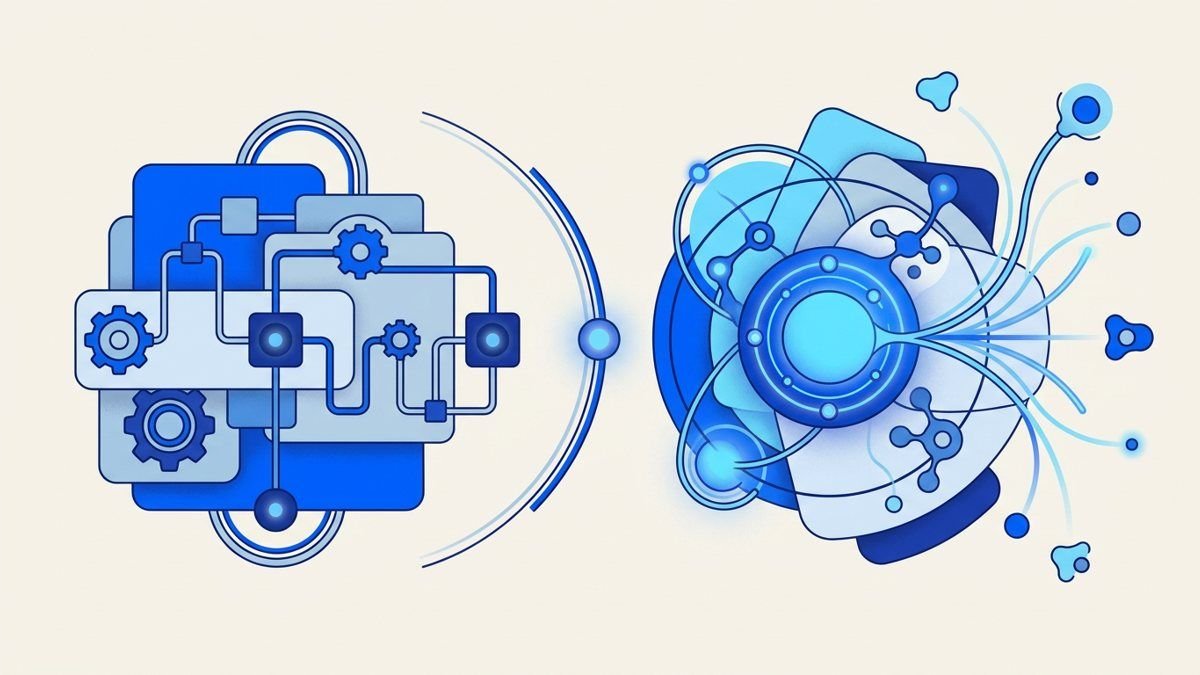
AI Agents vs Traditional Automation: What Should Your Business Build? is not mainly a technology question. It is a decision about workflow, data, model behavior, controls, and operations. Teams get into trouble when they select a tool or feature before agreeing on the business behavior that needs to change. Distinguish deterministic workflow automation from agentic systems and choose based on risk, variability, and control.
Start with the decision, not the tool
The useful starting point is to describe the current situation in plain language. Who is trying to do what? What slows them down? What information do they need? What happens when the normal path breaks? A good answer exposes the real constraint. It may be missing context, weak trust, unclear ownership, inconsistent data, or an experience that asks too much before delivering value.
Define the outcome in observable terms
Then translate the problem into a measurable product or operational outcome. Avoid goals such as "use AI," "modernize," or "improve the UX." Prefer a statement such as: reduce the time required to complete a task, increase the percentage of users reaching a meaningful milestone, lower preventable errors, or give operators reliable visibility into exceptions. A concrete outcome gives the team a way to compare options and say no to attractive distractions.
A practical framework
A practical framework is:
- 1Define the business decision or task
- 1Set the context and data boundaries
- 1Design failure and approval paths
- 1Evaluate realistic cases
- 1Monitor behavior, cost, and latency
The failure mode to watch
The most common failure is treating the visible interface as the whole solution. In reality, the result depends on the surrounding system: data quality, permissions, integrations, ownership, support, analytics, and the behavior of people who must adopt it. A polished screen cannot compensate for a workflow that remains unclear or a system nobody trusts.
Protect the learning in the first release
For a first release, protect the learning objective. Build only enough to test the central assumption with realistic users and operating conditions. Define what success, failure, and "needs another iteration" look like before launch. That makes the project a controlled decision rather than an expensive act of optimism.
Final thought
The right answer to ai agents vs traditional automation: what should your business build? is rarely a universal best practice. It is the approach that fits the product stage, risk, users, operating model, and evidence available now. CodersDive helps teams turn that context into a focused plan, a credible release, and a system they can continue to own.
focused discovery or product engineering engagement.
The bridge between traditional automation and agentic systems is not a binary switch, but a spectrum defined by the volatility of the input data and the cost of an incorrect outcome. To decide where to invest, engineering leaders must evaluate how much reasoning is actually required versus how much logic is simply being obfuscated by poorly structured data.
Assessing Variable Input Surface Area
Traditional automation thrives in a closed-loop environment where the schema is known. If you are syncing data between a CRM and an ERP via a webhook, the "surface area" of the input is small. Even if the data is massive, it is predictable. Adding an AI agent to this flow is an engineering anti-pattern that introduces "nondeterministic drift"—where the same input might result in different outputs over time due to model updates or temperature settings.
However, once the input surface area expands to unstructured data—such as long-form customer emails, messy legal contracts, or multi-modal inputs—standard logic gates break. An agent is the correct architectural choice when the "pre-processing" phase of a task requires semantic understanding rather than regex patterns.
The Volatility Check: 1. Input Schema: Is the incoming data structured (JSON/SQL) or unstructured (Text/Voice)? 2. Logic Stability: Does the decision-making logic change based on the content of the data, or is it a fixed set of If/Then rules? 3. Recovery Path: If the logic fails, can a human identify the break-point in a log file, or does it require re-interpreting the "intent" of the AI?
If your process requires interpreting intent to determine the next step, you are in the agentic domain. If you are simply mapping fields, stay deterministic.
The Cost of Latency and Token Overhead
One of the most overlooked trade-offs in the agent vs. automation debate is the operational cost of "reasoning." Traditional automation is nearly instantaneous and essentially free at the infrastructural level (pennies per million executions). Agentic systems, conversely, introduce significant latency and a recurring cost known as the "reasoning tax."
When an agent performs a task, it often involves multiple LLM calls: one to plan, one to execute, and one to verify. This creates a compounding effect on both time-to-resolution and API costs. For high-volume, real-time operations—such as algorithmic trading, high-speed inventory updates, or real-time fraud flags—the 5-to-30-second delay inherent in agentic loops is often unacceptable.
Metric to Watch: Unit Economics of the Result. Calculate the cost of a human performing the task manually versus the total token cost plus the engineering hours required to monitor an agent. If the agentic system costs more than 20% of the human cost, the ROI is likely a mirage created by hype rather than efficiency. Traditional automation should always be the default until proven insufficient.
The "Human-in-the-Loop" (HITL) Integration Pattern
The most effective B2B implementation of agents is not autonomous "set and forget" systems, but rather "Co-Pilot" architectures where the agent handles the synthesis and the human handles the execution. This hybrid approach mitigates the hallucination risks of AI while leveraging its ability to handle high variability.
Consider a multi-million dollar procurement process. A traditional automation cannot read 50 different vendor PDF formats to summarize risks. An agent can do this efficiently, but allowing that agent to automatically sign the contract is a catastrophic risk. The optimal design uses an agent to extract data, flag outliers, and prepare a draft, while a deterministic workflow triggers a Slack notification for a human to hit "Approve."
Decision Framework for Autonomy: * Low Stake / High Volume: (e.g., categorizing support tickets) -> Full Agent Autonomy. * High Stake / Low Volume: (e.g., quarterly financial audits) -> Agent Research + Human Review. * High Stake / High Volume: (e.g., medical billing or banking transactions) -> Strict Deterministic Automation with Agent-assisted Error Logging.
Frequently asked questions
Can I convert my existing Zapier or Tray.io workflows into AI agents? You should not convert them for the sake of novelty. If a workflow is currently working without errors, it is already optimized. Only introduce an agent if the workflow is currently breaking due to "fuzzy" data that requires a human to manually fix or re-run the process. Agents should replace human intervention points, not functioning code.
What are the primary signals that an agentic system is failing? The most common signals are "hallucination rate" and "looping." Hallucination occurs when the agent identifies a logical path that doesn't exist, while looping occurs when the agent repeatedly tries the same unsuccessful tool call because it cannot reconcile its instructions with the data. Monitor your "tokens per successful outcome" metric; if it spikes significantly, your agent is likely stuck in a logic loop.
How do I choose between a single complex agent and multiple simple automations? Complexity is the enemy of reliability. Whenever possible, decompose a business process into several deterministic automations connected by one small "routing" agent. This is known as a "modular agentic" architecture. It allows you to debug specific parts of the pipeline without having to diagnose the opaque "thoughts" of a massive, monolithic AI system.
Have a similar decision in front of you? Talk to CodersDive about a focused discovery or product engineering engagement.
Discuss your product AI Engineering
How to Find the First AI Use Case Worth Building
Prioritize a narrow workflow with clear pain, available data, measurable value, and safe human oversight. Read a practical framework from CodersDive.
 AI Engineering
RAG Explained for Product Leaders
Explain retrieval-augmented generation in business terms, including what it solves and where it fails. Read a practical framework from CodersDive.
 AI Engineering
The Hidden Work Behind a Reliable AI Copilot
Show that prompts are only one layer; useful copilots require data, context, permissions, evaluations, and operations. Read a practical framework from Code.